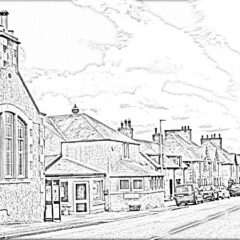
Much of this information was taken from Ian Abernethy’s book ‘The High Toun on the Hill’.
Near Heiton Mill, in 1932, a cist was discovered which contained an unburnt skeleton and a pottery vessel: the pottery vessel dated the skeleton to between 1700 and 1600 BC. Other cists of a similar age have been discovered around Heiton.
The first owner of the manor of Heiton was Alan de Perci the Younger, who fought at the Battle of the Standard in 1138. Various charters and grants of land were awarded to noblemen and religious orders, with the names of the land being variously known as Hetun or Heton.
The sixteenth century, after Flodden, saw the lands of Heytoun repeatedly being attacked, with (it is supposed) the burning of the village in 1522, and the burning of Sunlaws in 1544. In September 1544, the Earl of Hertford made a foray into Scotland destroying the abbeys of Kelso, Dryburgh, Melrose and Jedburgh as part of the ‘Rough Wooing’. Alongside the abbeys, Maisondieu, Heyton-on-the-Hill, Sunlaws, Ormiston and Roxburgh were also destroyed.
In the seventeenth century, James Ker of Chatto bought Sunlaws, and in the eighteenth century the village became a focal point to house the workers that supported the three estates that were near the village: Ladyrig (which was later sold to the Merchant Maiden hospital), the Springwood estate and, most importantly for the village, Sunlaws.
There was a long association between the Kerr family and the Jacobite cause: Robert Kerr, a son of the owner, travelled with the highlanders, was captured at the Battle of Preston and transported to Maryland, where he died.
The earliest mention of a school in Heiton was 1704. The school was originally run under the control of heritors, an unelected body consisting of landowners within the parish. Their duties, in addition to the school, included the upkeep of the manse, the minister’s stipend and administrating the poor relief.
In 1746, the Merchant Maiden Hospital, a charitable foundation, purchased the lands of Heiton from Ker of Greenhead – 887 acres – for £5,236 18s 4d. The associated farm was criss-crossed with unmade tracks where the coal, on pack horses, was transported from Northumberland to the Kelso area.
There were two ways of crossing the Teviot to Roxburgh; one was by the ford at Roxburgh Mill, the other was by ferry. It made Sundays for Heiton folk expensive: as well as the amount put on the collection plate in church, the ferry also had to be paid for. The boathouse was also a popular place for alcohol…
The skyline of Heiton is dominated by Bowmont Forest: but this was a windswept moor in the eighteenth century and was the site, at the time, of the second most important racecourse in Scotland. The races were held a couple of times a year and were popular: in 1813 a One Hundred Guineas Gold Cup was introduced. But various pressures on the racecourse saw it planed with trees and, despite the trees being burnt down in protest, no other race was run there. The first race was run at Kelso’s Berry Moss in 1821.
In 1803, the minutes of a meeting reported that the younger children on the south side of the parish (Heiton), were not receiving the same education as those on the other side of the Teviot (the school was in Roxburgh). As a consequence (some 20 years later), the first lesson was taught in Heiton. There was a disparity in pay: In 1861 the Roxburgh teacher earned £35pa, while the Heiton teacher earned £20 pa, even though the Heiton teacher had more pupils. When the Heiton teacher found this out, he resigned on the spot. There were about 90 children in the school, although it is doubtful that they all attended all of the time.
The teaching row escalated, as the male teacher was replaced with a female teacher. But Miss Sloan was allowed to get on with the job, and further reports indicated that she did a good job, along with her Assistant Teacher Elizabeth Stewart, a fourteen year-old that managed her class successfully. But Miss Sloan also looked to increase school fees, and when this was refused, she also resigned. Parity in teaching pay did not occur until 1880.
This article is in progress…