Sir George Brisbane Douglas, Bart., was never destined to be a laird – he was the second son of the fourth baronet, Sir George Henry Scott Douglas, and chose an academic career for himself until his ambitions were tragically cut short by the death of his elder brother. James had followed his father and pursued a military career: he was a lieutenant in the 21st Royal Fusiliers and was carrying despatches when he was ambushed by Zulus and killed at Kwamagwasa, South Africa, in 1879.
This meant that George became the fifth baronet and laird of the Springwood Park estate on the death of his father in 1885 which involved taking on the many responsibilities that such a position demanded. Even so, Sir George never abandoned his love of literature and became a prolific poet and author. He also had a passionate love of local characters and customs, making copious notes and penning essays about Gypsies, poaching, marriage customs and Border life in general. A valuable source for such material was his gamekeeper, George Landels, but Sir George was also able to relate to his many tenants and village folk and was not known to ‘stand on ceremony’.
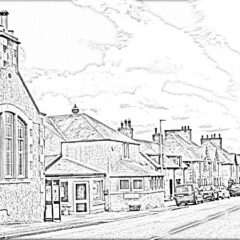
It is from Sir George that we get an impression of Heiton in the 19th century: A solitary street, – if one may call that a street which is by no means regular, and has little traffic. There were few cottages then that were not of the clay and straw type, with their red brick chimneys (commodious for the snow-balls of mischievous schoolboys) and the rich green velvet mossing of their thatch. At a date somewhat earlier yet, I have heard that each house had a little plank drawbridge in front of it, to be used for crossing the channel in which superfluous waters ran down uncovered before the doors.
Alexander Jeffrey, in his ‘Histories and Antiquities of Roxburghshire’ (1859) describes the village as: A row of houses on each side of the turnpike road leading from Berwick to the western districts of the country. The houses are generally of an inferior kind.
A report on the cottages in 1848 found that the cottages were: …of a very inferior description and several are in a nearly ruinous state.
A further report in 1866 described them as having, for the most part, only a single room and very damp. How then, did such a straggle of cottages merit two inns and several ‘beer houses’? An inn offers accommodation, and stabling for horses but Heiton is only a couple of miles from Kelso where there were many inns and ample stabling. The beer houses are easy enough – simply one of those run-down cottages with a barrel in the corner. The smiddy often had a barrel of beer available and I imagine many a ploughman taking his horse to be shod in the evening would be very grateful for a glass of ale as he waited.
Perhaps the reason for the inns was inadvertently included in a letter to the ‘Kelso Chronicle’ in 1870 demanding that the Red Lion have its license withdrawn: It has often struck me as being somewhat anomalous that a village like Heiton should have a licensed house, being in such close proximity to Kelso, while other villages such as Ednam, Sprouston, etc have been denied of their licensed houses. True, Heiton once boasted two public houses, the Spread Eagle and the present Red Lion. That was in the days before the railway traffic was opened up, in the days when the Jedburgh and Kelso coach used to run, when the Hawick and Kelso carriers used to do duty, and when the coal traffic through the village was very great.
The anonymous writer misses a further opportunity for the inns – the racecourse at Caverton Edge. Races had been held there since the 1730s and it became one of the principal race meetings in Scotland. The Caledonian Hunt Ball, held in Kelso, was hugely popular with the gentry and aristocracy, while large prizes attracted top runners and stabling was in great demand along with accommodation. Softlaw and Ladyrig provided extra stables but the Spread Eagle and Red Lion would have prospered. Perhaps the removal of the races to Blakelaw in 1821 contributed to the demise of the Spread Eagle.
A further letter was written shortly after, which broadly supported closing village inns but also looked back with some nostalgia: Your correspondent’s mention of the ‘Spread Eagle’ and ‘Red Lion’ in Heiton has recalled to my memory the light of other days. I can recollect well the landlady of the ‘Spread Eagle’, Peggy Scott, as she was called, and the landlord of the ‘Red Lion’, and I can well remember the little jealousies that existed between the two rival houses, sometimes culminating in other than complimentary language on both sides. Contemporaneously with them was Jenny Hogg of Roxburgh boathouse, and what lover of the ‘gentle art’ did not ken Jenny? And who that ever partook of her ‘ham and egg’ ever wished for better? And if they wished for a ‘wee drap of the crater’ they were sure to get the ‘rael Willie Arnot’ or genuine mountain dew…

A map drawn in the mid 1850s shows the Spread Eagle at the north end of the village, next to the farm steading where later farm cottages were placed. It seems to show the inn, two detached buildings and two wells. It seems reasonable to assume that one outbuilding would be stabling, while the other is a smiddy which would be handy for sorting horses with cast shoes.
The earliest tenant I can find was John Scott and there is a mention in the ‘Kelso Chronicle’ in 1846 concerning a prodigious carrot! There was taken from the garden of Mr John Scott, of the Spread Eagle Inn, in the village of Heiton, a few days ago, a carrot, of the extraordinary weight of 26 ounces and measuring in circumference 12 inches.
Scott appears in the 1841 census as ‘Innkeeper’ but, sadly, by the time of the 1851 census, John had died and the inn was being run jointly by his widow, Margaret Scott, and a blacksmith, Alexander Purves. In 1858, John Speirs was fined for keeping his house open after eleven o’clock at night. He also features as ‘Innkeeper’ in the 1861 census and almost certainly took over the Spread Eagle from Margaret.
The Red Lion has left a larger footprint on history as it survived until the 1870s. In 1851, William Miller was the innkeeper although he may have had forebodings of the way things were going – a year earlier, in October 1850, the Total Abstinence Society met next door, in the school room, and thirty-one people were enrolled as members of the society. The location of the Red Lion is easy to find as it occupied the space between the school and the village hall. If you follow the roof ridge line between the two buildings, you will see they match perfectly.


In fact, what is now the hall was the stables and gig house for the inn and there exists a plan showing the layout. An upper floor stored hay and straw but, when swept, it doubled as a dance hall for the village and had a hatch for the sale of drinks.
The tenancy appears to have changed regularly and perhaps this is a symptom of a decline in trade. In 1859, Alexander Waugh, a local farmer, was made bankrupt but we see a transfer of the liquor license to him in the Red Lion. In truth, the inn cannot have been viewed as a den of iniquity as the Sabbath School Soiree was held in their ‘large room’ in 1869! A report in the ‘Kelso Chronicle’ in January 1866, illustrates an important function of the inn: In the evening, a ball took place at the Red Lion Inn (Mr Waugh’s) which was well attended and went off to the satisfaction of all present.
Another report from 1871 shows the old custom still being maintained: On Friday evening last the annual New Year’s ball took place in the Red Lion Inn ball-room, when there was a very large attendance. Dancing began about nine o’clock, and was kept up with great spirit until an early hour in the morning. Everything passed off in excellent style, and the company were highly pleased with the evening’s enjoyment.
A regular occurrence was the prosecution of the tenant for contravention of the licensing laws such as selling spirits to people who weren’t bona fide travellers on the sabbath. The landlord in the 1870s was William Wales and he was fined twice for this offense. It seemed that local opinion regarding the Red Lion was now divided and, as we saw from the anonymous letter in 1870, pressure was building to have the inn closed. The actions of William Wales resulted in him having his license revoked but, in May 1874, he appealed, employing a solicitor to represent him.
A petition was presented supporting Wales but a counter petition was also produced and the opinion of William Scott Kerr was sought. He claimed that the inn was: …a perfect disgrace to the village and he did not see that there was any use for such in the locality as the population consisted chiefly of agricultural labourers. He said with regard to the balls held at the hotel in the winter, they were most disagreeable meetings. In referring to the petition presented by Mr Elliot, he said it was signed principally by single men in the district, while the petition against the granting of the license was signed by farmers, landed proprietors and a great many married men in the district.

Mr Scott Kerr was a Justice of the Peace and a gentleman whose views carried considerable weight in the district. Unsurprisingly, the appeal of William Wales was dismissed. The Red Lion was closed down finally a year later, in 1875, and the inn found a new life as the village post office.
It should, perhaps, be noted that William Scott Kerr himself was the owner of a handsomely stocked wine cellar and, when Sunlaws was destroyed by fire in 1885, the ‘Hawick News’, reporting on the matter, said: The wine cellar, containing a quantity of very old port may also have escaped, as it was arched over.
I am unable to say whether the port escaped but the only place to survive the devastating fire was the wine cellar which is still there to this day.
It may be instructive to read an account, written in 1899, of the ‘most disagreeable’ dances at the Red Lion viewed by another Justice of the Peace and a local laird whose properties included the defunct Spread Eagle: But of course, the great event of the day, or night, was the ball. It was held in the village ‘public’, the landlord obtaining a special permission in honour of the occasion, to keep his house open till three o’clock. White was the ball-going attire most affected by the girls of the High Town at that date – white, which they would relieve effectively with coloured ribbands and artificial flowers. And winsome, indeed, did some of them appear when thus bedecked. The ball-gowns had been the subject of much artless scheming in anticipation, for there was always an official Queen of the Ball, and great and universal was the ambition to be chosen to fill this part. At one period, however, the honour generally fell to the lot of the ‘maiden’ in service at the tavern. Her household duties would prevent her appearing in the ball-room during the earlier part of the evening; but ‘nae time’s owergane’ as the proverb says, for when at last she was free to make her toilet and take her place among the dancers, the advantage in freshness of dress and complexion was all upon her side. Then the custom was that she should give her hand to a certain antiquated ‘worthy’ of the place, who was noted for his skill in dancing, and with him lead off the intricate contre-danse, which is known as ‘Keep the Country’. Here was then a subject for the pencil of a Wilkie, or, still better, for that of Wilkie’s Border follower, Lizars, whose memeory is still kept green by two delightfully humerous paintings from his hand which hang in our National Gallery.
Not only the figure, but also the music of the country-dance was extremely difficult; and this brings me to those on that night most important functionaries, the fiddlers. One of these, who had in his boyhood been a playmate of the writer’s father, was to the writer himself, perhaps, one of the truest friends he ever had; the other was an old ‘character’, invariably known by his local name of Will ‘Pull’. [Real name: William Hall.] Will was a thatcher to his trade (it is not easy now to find one in the district when a job has to be done), and he employed a stout boy as assistant. When Will was at work upon a roof, the boy could be within to draw the needle, and the signal for his doing this was his master’s shouting the word ‘Pull!’ which he did in a peculiar and inimitable manner that was all his own. Hence the nickname.
An extract from Diversions of a Country Gentleman by Sir George Douglas, Bart (Hodder & Stoughton, 1902)
I leave it to the reader to decide whether the Red Lion was a sink of depravity and degradation, or a place for the hard-working villagers of Heiton to congregate and let their hair down.
28th December, 1922 – A large crowd attended the opening of the new or re-modelled hall at the village of Heiton… The occasion was marked by eloquence, music and dancing. Sir George Douglas, Bart., Springwood Park, Kelso, whose estate includes Heiton, presided and opened with a charming speech.
31st January, 1924 – Brigadier General Scott Kerr of Sunlaws presided over a large company in Heiton Hall on Friday evening on the occasion of the first Burns celebration held in Heiton.
A few weeks later, the entire committee appeared in court accused of ‘Trafficking in liquor without a certificate’! A plea of ‘Guilty’ was entered but ‘A very prominent gentleman in the district’ (i.e. General Scott Kerr who had presented three bottles of whisky) had sent a letter stating that the offense was quite unintentional and that the supper was conducted in every way quite satisfactorily. The prosecution insisted that it was a clear case of trafficking and each member of the committee was liable to a fine not exceeding £50. After a short consultation, (during which, I imagine, they fought to contain their amusement) the justices said that they were satisfied that the offense had been committed – They had decided to have a jolly good night – and quite right too – but they should have got someone to cater for them.
Each of the accused was fined five shillings.
Ian Abernethy, 2024.